Growth & Continuity Formula : Defend / Adapt / Transform
ARTICLES
3 Horizons, 1 System (3H1S)
What Is 3H1S — Three Horizons, One System?
3H1S stands for Three Horizons, One System.
The expression is deliberate. It is not a variant of the Three Horizons model, but a clarification of how the model is meant to be understood and used according to AUGMNT.
The Three Horizons describe different temporal logics within an organization:
-
Horizon 1 concerns what currently sustains performance.
-
Horizon 2 concerns transition, adaptation, and emerging alternatives.
-
Horizon 3 concerns longer-term transformation and future relevance.
These horizons are often presented as separate domains of work. When treated this way, organizations tend to over-invest in one horizon—usually the first—while neglecting the others.
3H1S rejects that separation.
The “one system” means that all three horizons coexist and interact within the same organization, at the same time. They are not sequential phases, departments, or optional initiatives. They are simultaneous operating logics within a single system. Sharpes work is consistent with this view, it presents the horizons as all happening in the present.
Decisions made in Horizon 1 shape what becomes possible in Horizon 2.
Experiments in Horizon 2 determine whether Horizon 3 intentions can ever materialize.
Images of the future in Horizon 3 influence what is defended, funded, or constrained in Horizon 1.
Seen this way, the organization does not move from Horizon 1 to Horizon 3. It matures by learning to coordinate across all three horizons without fragmenting itself.
Two Interpretations of the Three Horizons
To deepen our understanding of the 3 Horizons and the 1 System proposition, we must know that the Three Horizons framework has been articulated in two influential but distinct ways.
The McKinsey way
The McKinsey interpretation presents the Three Horizons as a growth and performance framework.
Horizon 1 focuses on the core business and current performance.
Horizon 2 represents emerging opportunities, adjacent businesses, and extensions of the core.
Horizon 3 explores longer-term options, new business models, and future sources of growth.
The emphasis is on resource allocation, portfolio balance, and sustaining growth over time, with horizons often discussed in terms of investment and revenue contribution.
The Sharpe way
The Bill Sharpe’s interpretation approaches the Three Horizons as a framework for navigating systemic change.
Horizon 1 represents the dominant system and prevailing ways of doing things.
Horizon 3 represents fundamentally different futures that challenge existing assumptions.
Horizon 2 is the space of transition and tension, where new practices struggle to emerge while the old system resists.
This version emphasizes patterns of change, narratives, power, and legitimacy, rather than portfolio optimization.
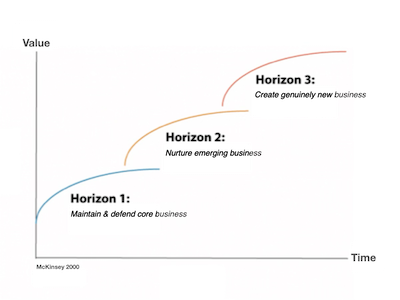
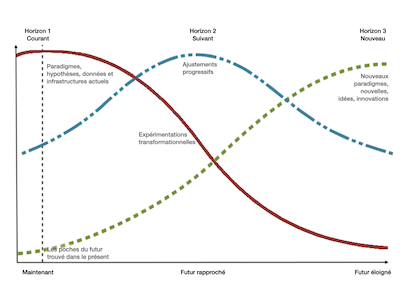
While both use the same horizon structure, they differ in intent. McKinsey’s version is oriented toward managing growth within organizations. Sharpe’s version is oriented toward understanding and shaping transformation within systems.
3H1S draws from both, while insisting that all three horizons operate simultaneously as one system
What Is 3H1S — Three Horizons, One System?
3H1S stands for Three Horizons, One System.
The expression is deliberate. It is not a variant of the Three Horizons model, but a clarification of how the model is meant to be understood and used according to AUGMNT.
The Three Horizons describe different temporal logics within an organization:
-
Horizon 1 concerns what currently sustains performance.
-
Horizon 2 concerns transition, adaptation, and emerging alternatives.
-
Horizon 3 concerns longer-term transformation and future relevance.
These horizons are often presented as separate domains of work. When treated this way, organizations tend to over-invest in one horizon—usually the first—while neglecting the others.
3H1S rejects that separation.
The “one system” means that all three horizons coexist and interact within the same organization, at the same time. They are not sequential phases, departments, or optional initiatives. They are simultaneous operating logics within a single system. Sharpes work is consistent with this view, it presents the horizons as all happening in the present.
Decisions made in Horizon 1 shape what becomes possible in Horizon 2.
Experiments in Horizon 2 determine whether Horizon 3 intentions can ever materialize.
Images of the future in Horizon 3 influence what is defended, funded, or constrained in Horizon 1.
Seen this way, the organization does not move from Horizon 1 to Horizon 3. It matures by learning to coordinate across all three horizons without fragmenting itself.
Why the “One System” Matters
3H1S rejects that separation.
The “one system” means that all three horizons coexist and interact within the same organization, at the same time. They are not sequential phases, departments, or optional initiatives. They are simultaneous operating logics within a single system.
Decisions made in Horizon 1 shape what becomes possible in Horizon 2.
Experiments in Horizon 2 determine whether Horizon 3 intentions can ever materialize.
Images of the future in Horizon 3 influence what is defended, funded, or constrained in Horizon 1.
Seen this way, the organization does not move from Horizon 1 to Horizon 3. It matures by learning to coordinate across all three horizons without fragmenting itself.
The emphasis on one system is what allows 3H1S to function as a maturity model.
Immaturity is not defined by being “too operational” or “not innovative enough.” It is defined by collapse:
-
collapsing everything into short-term execution,
-
or isolating transformation as an abstract future exercise disconnected from present decisions.
Maturity, by contrast, is the capability to hold tension across horizons:
-
to protect today without sacrificing tomorrow,
-
to explore change without destabilizing the core,
-
and to prepare for futures without turning them into slogans.
In this sense, 3H1S describes a form of systemic maturity: not progression through stages, but the ability to operate complexity over time as one coherent whole.
Growth+Continuity
Alpha program
Strategic Risks
Diagnostics
Workshops+Trainings
Futures Literacy
Awareness
Alternatives
Agency
Alignment
Contact
Transactions
Questions
Comments
Linkedin
Legal
Terms Of Use
Privacy
Cookie Policy
Intellectual Property
Affiliate Disclosure