
Cognitiv MAPS™
COGNITIV MAPS™
BUSINESS as a Cognitiv MAP™
A Cognitiv MAP™ is a structured visual representation of an organization’s actual reality — made explicit, inspectable, and strategically actionable. When an organization can see itself clearly — its structure, its assets, its horizons, its exposures — it can make decisions that were previously unavailable, and avoid the ones that were silently inevitable.
What a Cognitiv MAP™ is not
A Cognitiv MAP™ is not a report — it does not describe what happened. It is not a framework — it does not prescribe what to do. It is not a strategy deck — it does not argue a position. It is not an org chart — it does not show hierarchy. It is a map — which means it shows what is actually there, where it sits, and how it relates to everything else.
MAPS = FOUNDATIONAL + APPLIED
What are the Cognitiv MAPS™ of a BUSINESS
FOUNDATIONAL MAPS
Foundational MAPS describe the irreducible dimensions of any organization. They make visible the organization’s actual structure, its assets in the broad sense, and its time horizons—the basic realities from which all strategic decisions are made.
These maps form a common ground. They are not tied to a specific objective or situation. They allow the organization to see how it truly operates before engaging in strategy, risk analysis, or transformation.
Without explicit Foundational Maps, other analyses rest on assumptions. With them, strategy starts from a clear and shared understanding of reality.
APPLIED MAPS
Applied MAPS build on the Foundational MAPS to explore, test, and structure specific strategic questions. They are used to work on strategy, risk, business models, scenarios, and complex decisions, starting from an already visible reality.
Each Applied MAPS produces a focused representation, oriented toward action or decision.
They do not replace the foundations—they rely on them.
Applied MAPS translate organizational understanding into choices, trade-offs, and concrete direction.
MAPS AT WORK
What MAPS are used for
1. Augmented Cognition
MAPS provide a shared cognitive reference that makes structure, assets, and horizons visible at the same time. They allow leaders and teams to reason from the same representation of reality when making decisions.
3. StrategIQ Watch
MAPS support continuous macro- and micro-level monitoring of structural, economic, and temporal dynamics. They help track emerging risks, opportunities, and shifts as they develop across horizons.
2. Growth + Continuity Plan
MAPS enable Growth + Continuity to be addressed together by aligning ambitions with structure, assets, and constraints. They support coherent planning that preserves what must endure while enabling change where needed.
4. StrategIQ Plan
MAPS form the foundation of a strategic plan grounded in observable reality rather than assumptions. They translate visibility into clear priorities, trade-offs, and strategic direction across time.
Who are these MAPS for?
MAPS are aimed at founders, owners, leadership teams and managers – who are navigating growth, change and strategic uncertainty.
How MAPS are built
MAPS are built using models during working sessions or workshops, depending on the context and the organization’s challenges.
Assistance, delegation
Certain components of MAPS can be delegated to us in close collaboration with management teams.
GROWTH + CONTINUITY IN THE COGNITIVE ERA
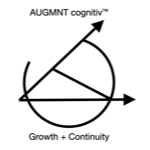
Growth + Continuity In The Cognitive Era
When change is accelerating and augmentation is the new game, Growth and Continuity are at risk when organizational intelligence is implicit. Cognitiv Business™ addresses both at the root: by making your organization’s knowledge, logic, and decision capacity explicit and structural across all its horizons, it creates the conditions for growth that doesn’t dilute and continuity that doesn’t fracture at the pace of rapid technological change and shifting economic conditions.
FOUNDATIONAL MAPS
Foundational MAPS
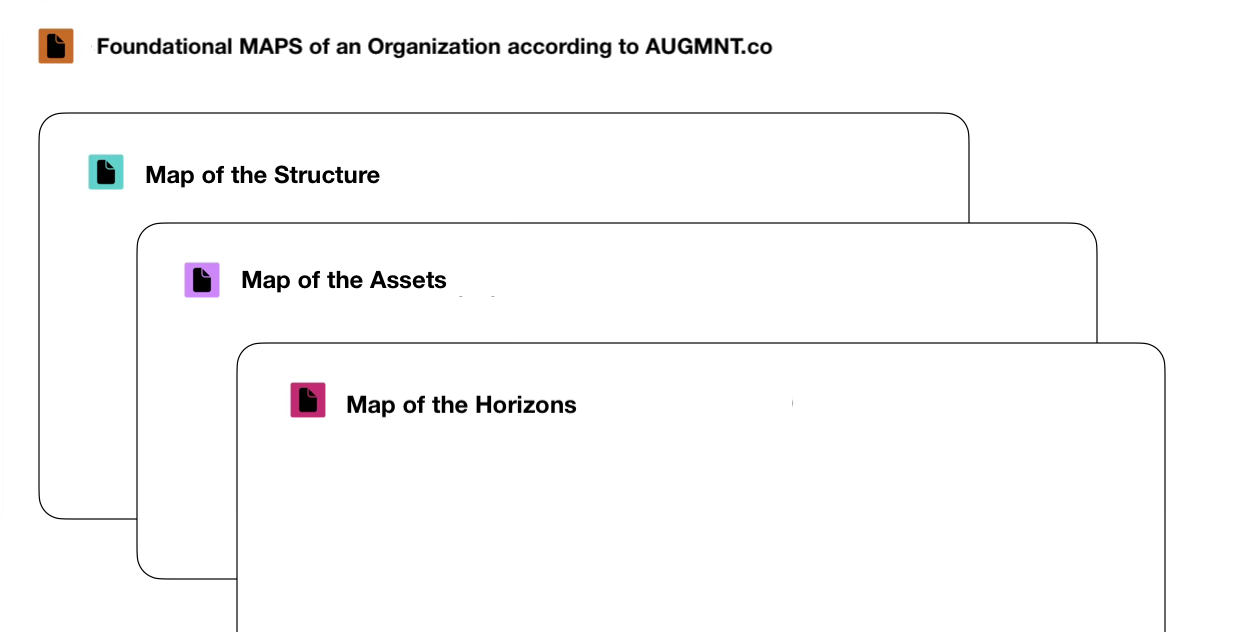
Every ORGANIZATION operates simultaneously across three irreducible dimensions: how it is structured, what assets it holds, and where it stands in time. The three Foundational MAPS make each dimension explicit, inspectable, and strategically actionable — together, for the first time, as a coherent whole.
Structural MAP
STRUCTURE
Structural MAP shows how the organization’s essential structural functions are handled in practice — not on paper, not by title, but in day-to-day operation. It maps how structure governs, coordinates, and assigns responsibility across the full portfolio of assets — without exception — and how those responsibilities operate across Horizon 1 (Defend), Horizon 2 (Adapt), and Horizon 3 (Transform).
Economic MAP
ASSETS
Economic or Assets MAP examines the organization’s complete asset portfolio — tangible and intangible, seen or unseen, measured or unmeasured, owned or unowned — and makes them explicit, inspectable, and strategically positionable. It maps all asset categories and types — without omission — and positions each asset across the 3 Horizons: what is sustaining Horizon 1, enabling Horizon 2, or building Horizon 3.
Temporal MAP
HORIZONS
Temporal MAP explicitly maps the 3 Horizons themselves — Horizon 1 (Defend), Horizon 2 (Adapt), and Horizon 3 (Transform) — as interacting fields of strategic time. It makes visible how they coexist, conflict, and influence present decisions, and how the organization’s assets and structure are distributed across them. It allows us to see the dynamics of continuity or discontinuity.
Capabilities enabled
- map 5 organizational systems,
- attach structural responsibility to all assets,
- clarify structural ownership across H1, H2, and H3,
- distinguish structural issues from people issues,
- locate overload, gaps, and blurred responsibilities,
- see which functions are missing, collapsed, or dormant.
Capabilities developed
- inventory and classify the full asset portfolio,
- position every asset in H1, H2, or H3,
- surface hidden asset dependencies and risk concentrations,
- clarify the relationship between assets, structure, value, and risk,
- improve capital and attention allocation decisions.
Capabilities developed
- map the active logic of H1, H2, and H3,
- surface tensions between preservation, transition, and transformation,
- reveal horizon imbalance or collapse,
- reduce temporal blind spots and strategic drift,
- improve the organization’s ability to reason coherently across structure, assets, and the 3 Horizons.
APPLIED MAPS
Applied MAPS
Structured working sessions, each focused on a specific dimension of organizational cognition. Built collaboratively with leadership and their teams.
Strategic Risks
Map Strategic, Horizons and Future-as-risk Risks to learn to identify strategic risks before they become operational or financial problems and to understand risk emerging from the future.
Customers
Go beyond demographics and satisfaction metrics. Map evolving customer behavior, unmet needs, and future demand patterns all inside the important customer attitude culture.
The Unreasonable Competition
Competition is no longer only about efficiency. Map how unconventional moves, reframing, and strategic asymmetry reshape competitive landscapes.
Strategy Process
Strategy is not a document but a discipline and a process. This map clarifies how strategy making involves 3 distinct and progressive steps : thinking, development and planning.
Alternative Thinking & Futures
Challenge dominant assumptions and explore credible alternatives. This map helps develop the ability to think beyond default paths and inherited mental models.
Scenarios + Impacts
Move beyond storytelling with this map and learn how to use scenarios to explore implications, second-order effects, and strategic consequences — not just alternative thinking and futures.
Foresight/Prospective
A foresight map is a structured representation of possible futures and their implications for an organization. It makes visible how signals, trends, risks, and uncertainties may interact over time to shape decisions and outcomes.
Business Models
Reframe the business as a system of assets and capabilities. This map or canvas explores how business models evolve, where value shifts, and how to avoid being locked into past success.
Levels of Analysis
Learn to move between big-picture forces and local realities. Building and using this map sharpens the ability to connect global trends, industry dynamics, and organizational decisions.
Cognitive Blind Spots
Every organization runs on an invisible operating system — the mental models and cognitive biases that silently shape every decision. When that system stays implicit, it can’t be audited, corrected, or upgraded. This workshop makes it visible.”
Standard, Delegation and Protocol
Transform how authority and the execution of tasks & deliverables are transferred. Establish the standards that make tasks explicit, quality measurable, and outcomes reliable, whether delegating to humans or AI agents.
Contact us for more information or are ready to implement COGNITIV MAPS™.